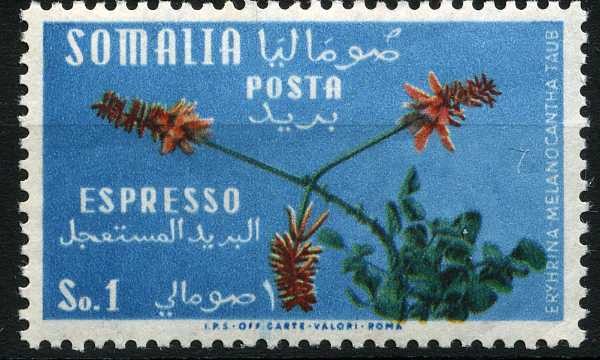
Erythrina melanacantha
Erythrina melanacantha (commonly known as the Somali Coral Tree) is a deciduous, drought-tolerant spiny tree in the legume family (Fabaceae), adapted to the semi-arid bushlands, dry acacia savannas, and rocky plains of the Horn of Africa. The species is easily recognized by its stout, corky bark studded with sharp, hooked black prickles and its trifoliate leaves, which shed during the intense dry season to conserve vital moisture. Before the new foliage emerges, the bare branches burst into dense, elongated racemes of fiery orange-to-scarlet tubular flowers.
The tree plays a vital socio-economic and ecological role in arid pastoral regions. Its soft, lightweight, and easily carved wood has long been crafted by Somali artisans into traditional camel bells (koor), milking vessels (haam), bowls, and stools. Furthermore, pastoralists frequently use its thorny branches to build protective livestock enclosures (zeribas), while its nectar-rich blossoms provide essential forage for sunbirds and bees during periods of drought. The artwork captures the vibrant, fiery floral spikes branching out from the spiny stem, showcasing one of the most distinctive dryland trees of Somalia.
The tree plays a vital socio-economic and ecological role in arid pastoral regions. Its soft, lightweight, and easily carved wood has long been crafted by Somali artisans into traditional camel bells (koor), milking vessels (haam), bowls, and stools. Furthermore, pastoralists frequently use its thorny branches to build protective livestock enclosures (zeribas), while its nectar-rich blossoms provide essential forage for sunbirds and bees during periods of drought. The artwork captures the vibrant, fiery floral spikes branching out from the spiny stem, showcasing one of the most distinctive dryland trees of Somalia.