Hirola / Hunter's Hartebeest (Beatragus hunteri / Damaliscus hunteri)
The Hirola (Beatragus hunteri, historically classified as Damaliscus hunteri), also known as Hunter's Hartebeest or the "four-eyed antelope," is a critically endangered antelope endemic exclusively to the arid grasslands and acacia savannas along the border region between southern Somalia and southeastern Kenya. It is easily recognized by its sandy-tawny coat, long white tail, sharp lyre-shaped ridged horns, and a distinct white chevron line running between its eyes. Its common nickname arises from its unusually large, dark preorbital glands beneath each eye, which appear as a second set of eyes when viewed from a distance.
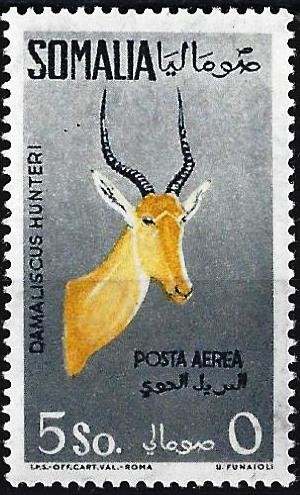
As a highly specialized grazer adapted to semi-arid ecosystems, the Hirola is an evolutionary relic—often referred to as a "living fossil"—and represents the sole surviving member of the genus Beatragus. Featured on a high-value airmail issue, the stamp portrait illustrates the antelope's alert head, facial chevron, and sweeping horns against a slate-grey background, highlighting one of the most distinctive and globally significant mammal species native to the Somali plains.
As a highly specialized grazer adapted to semi-arid ecosystems, the Hirola is an evolutionary relic—often referred to as a "living fossil"—and represents the sole surviving member of the genus Beatragus. Featured on a high-value airmail issue, the stamp portrait illustrates the antelope's alert head, facial chevron, and sweeping horns against a slate-grey background, highlighting one of the most distinctive and globally significant mammal species native to the Somali plains.